So, on the dawn of the day that the great diaspora known as the Bush Administration ("Administration," Ha! At least Nero fiddled while Rome burned!) is seeing its final days, I got to thinking:
Obama... opera.
Could there be a connection there, somewhere? Does our new prez-elect like opera? What does he think about it? What's his policy going to be on the Fine Arts?
So, like most i-idiots today, I googled "Obama opera."
What did I find? Well, what I found made me hope that Obama makes education a priority in our country.
The top link said "MySpace Videos: Obama and Opera by AAM." I should've red-flagged anything prefixed with "MySpace" as being spurious, but since this was an entirely unscientific experiment, merely relying on serendipity to yield its results, I went ahead and clicked.
Obviously, the video was of a rally, apparently in Cedar Rapids, Iowa. There were several people standing on a dais surrounded by a rowdy crowd of Obamanites. "Okay," I was thinking to myself, "some opera singer sang the National Anthem or something." Then Obama himself came up to the dais and began speaking. After a minute or two, I skimmed further through the video to find the part where the opera singer came in.
No such luck. No singing on that video. It was then that I noticed a rather portly African American woman on the dais with Obama. "Leontyne Price?" I thought. No. Though the video was a bit grainy, I could still see it wasn't Ms. Price. Kiri, maybe? No.
Finally I did recognize the person: It was Oprah!
Alright, so MySpace people aren't the brightest bulbs on the tree. Apparently, some folks were equally confused over on Yahoo, too. I suppose that I should forgive these (I'm assuming) kids or, perhaps, non-native speakers. After all, Oprah wasn't even supposed to be named Oprah. Oprah's given name was supposed to be the Biblical name "Orpah" (Ruth 1:4), but everybody apparently had a hard time pronouncing and spelling that in her native Mississippi.
So, no direct links between Obama/Biden and opera. But, I'm sure there's some greedy little composer in his parents' basement right now writing "Obama: The Opera." Don't be surprised when it comes out. Look for it at the Met in 2012.
FYI, a pdf of Obama/Biden's platform on the arts can be found here.
Wednesday, November 5, 2008


Monday, November 3, 2008
"Who's the new guy?"
No doubt, anyone paying attention during rehearsals for the recent Glitterville Gala noticed that there was a new face in the crowd in the orchestra. That new face is none other than associate concertmaster, Edward Pulgar. The Knoxville News Sentinel ran a story on him in this morning's edition under the rather uninspired title, "Government put music in his soul." Although, from the title, you might think that maestro Pulgars's violin prowess might have come about as the result of a DARPA experiment gone horribly wrong, the article is referring to the government of his home country, Venezuela.
Starting in the 1970s, a time when America's government had begun cutting Fine Arts programs to save money, the Venezuelan government saw fit to fund an ambitious program of classical music instruction for all of its children, especially those in the impoverished inner city, through the establishment of neighborhood music schools and the formation of local youth orchestras. The idea behind the program is that music can be both an escape and a way out of poverty for some of these kids.
Perhaps what is even more startling is that the Venezuelan government has kept funding "El Sistema" (The System) to this day. Along the way, it has produced crop after crop of talented and highly trained orchestral musicians and conductors which the world's orchestras have adoringly lapped up. A recent 60 Minutes video article (videarticle?) chronicled the rise of one of these young stars, conductor Gustavo Dudamel.
Knoxville has been the lucky recipient of El Sistema in the form of Edward Pulgar. He will be performing with other members of the KSO Principal Quartet (Sean Claire, Kathryn Gawne and Andy Bryenton) next Sunday at 2:30 pm at the Bijou Theater.
Thank goodness there's at least one government that cherishes classical music, eh? The United States continues to head down the path of eradication of all Fine Arts programs in all its schools under the auspices that our kids need more math and science. There are currently just two orchestral programs in Knox County schools, and those are poorly funded. The minimization of general music classes keeps kids from experiencing classical music, which, in turn, keeps the vast majority of them from continuing their studies. Thus, choral, orchestral, and band programs begin to wither away for lack of students.
"But just look at the Japanese and the Chinese," proponents of the art diaspora say, "our kids can't compete with them unless we bolster our math and science programs." Really? Have you checked out the ethnicity of many of the orchestras around the world. Seems there's a definite Asian faction there. So, somehow, the Chinese and Japanese manage to teach their kids math and science and music... oh, and don't forget, most of them have taken English their whole lives and can speak the language better than most native Anglophiles. Anata wa Nihon o hanashi masuka, America Iie? No?
Well, maybe your kids will do better in Venezuela. Most American high schools still teach Spanish, I think.
Starting in the 1970s, a time when America's government had begun cutting Fine Arts programs to save money, the Venezuelan government saw fit to fund an ambitious program of classical music instruction for all of its children, especially those in the impoverished inner city, through the establishment of neighborhood music schools and the formation of local youth orchestras. The idea behind the program is that music can be both an escape and a way out of poverty for some of these kids.
Perhaps what is even more startling is that the Venezuelan government has kept funding "El Sistema" (The System) to this day. Along the way, it has produced crop after crop of talented and highly trained orchestral musicians and conductors which the world's orchestras have adoringly lapped up. A recent 60 Minutes video article (videarticle?) chronicled the rise of one of these young stars, conductor Gustavo Dudamel.
Knoxville has been the lucky recipient of El Sistema in the form of Edward Pulgar. He will be performing with other members of the KSO Principal Quartet (Sean Claire, Kathryn Gawne and Andy Bryenton) next Sunday at 2:30 pm at the Bijou Theater.
Thank goodness there's at least one government that cherishes classical music, eh? The United States continues to head down the path of eradication of all Fine Arts programs in all its schools under the auspices that our kids need more math and science. There are currently just two orchestral programs in Knox County schools, and those are poorly funded. The minimization of general music classes keeps kids from experiencing classical music, which, in turn, keeps the vast majority of them from continuing their studies. Thus, choral, orchestral, and band programs begin to wither away for lack of students.
"But just look at the Japanese and the Chinese," proponents of the art diaspora say, "our kids can't compete with them unless we bolster our math and science programs." Really? Have you checked out the ethnicity of many of the orchestras around the world. Seems there's a definite Asian faction there. So, somehow, the Chinese and Japanese manage to teach their kids math and science and music... oh, and don't forget, most of them have taken English their whole lives and can speak the language better than most native Anglophiles. Anata wa Nihon o hanashi masuka, America Iie? No?
Well, maybe your kids will do better in Venezuela. Most American high schools still teach Spanish, I think.
Sunday, November 2, 2008
Post-Production: Glitterville Gala/Concert
* Tons of people - had a good time; lots of costumes; but ran out of food;
* Concert - well enough
A couple of impressions about last night's KO Glitterville Gala/Concert at the Tennessee Theater:
And how about Stephen Brown's decorations! You know, Halloween is really a kind of low-brow holiday. Other than Christmas, it's probably the easiest holiday to make tacky if you're not careful. Wel, duh! Of course, Stephen Brown's going to be careful! Everything just reeked of classiness. (I have to admit, though, that I didn't get to get too close a look at what all was put out.) Amazing that a kid from Rockwood, which, I'm sure Stephen would admit, isn't exactly a cultural mecca, world go on to be fawned over by companies and well-to-dos world-wide for his taste and style in decorating for special occasions. As I'm sure they would say in Rockwood, "Ya done good thar, boy!"
The concert, likewise, seemed to go okay. As is usually the case with these kinds of things, the chorus kind of forgot their dynamics and fell back on the the old habit of loud-louder-loudest. It's always harder to sing very softly when you, as a performer in front of an audience, let the adrenaline run haywire. It does make for a lively performance, though. I think the "Sweeney Todd" scenes had a lot more energy than any rehearsal we had. Kudos to everyone for not letting that energy get out of hand on the fugal sections. Really easy to do that, too, when you're pumped for a performance.
Oh, well. We put that one to bed. But, ever vigilant, we start "Rigoletto" rehearsals next week. See ya then.
P.S. Like a total spaz, I never could remember my camera; however, Martin brought his and filled up an entire 2 Gb card with photos which he's posting on Flikr. When he gets them up on the web, I'll ask him for a link to them.
* Concert - well enough
A couple of impressions about last night's KO Glitterville Gala/Concert at the Tennessee Theater:
- There was a ton of people there
- Everybody had a great time
- More hors d'oeuvres next time
- I actually have a voice left with which to sing at church this morning
And how about Stephen Brown's decorations! You know, Halloween is really a kind of low-brow holiday. Other than Christmas, it's probably the easiest holiday to make tacky if you're not careful. Wel, duh! Of course, Stephen Brown's going to be careful! Everything just reeked of classiness. (I have to admit, though, that I didn't get to get too close a look at what all was put out.) Amazing that a kid from Rockwood, which, I'm sure Stephen would admit, isn't exactly a cultural mecca, world go on to be fawned over by companies and well-to-dos world-wide for his taste and style in decorating for special occasions. As I'm sure they would say in Rockwood, "Ya done good thar, boy!"
The concert, likewise, seemed to go okay. As is usually the case with these kinds of things, the chorus kind of forgot their dynamics and fell back on the the old habit of loud-louder-loudest. It's always harder to sing very softly when you, as a performer in front of an audience, let the adrenaline run haywire. It does make for a lively performance, though. I think the "Sweeney Todd" scenes had a lot more energy than any rehearsal we had. Kudos to everyone for not letting that energy get out of hand on the fugal sections. Really easy to do that, too, when you're pumped for a performance.
Oh, well. We put that one to bed. But, ever vigilant, we start "Rigoletto" rehearsals next week. See ya then.
P.S. Like a total spaz, I never could remember my camera; however, Martin brought his and filled up an entire 2 Gb card with photos which he's posting on Flikr. When he gets them up on the web, I'll ask him for a link to them.
Friday, October 31, 2008
"Phantom" facts (or why you'll never see it at the Tennessee)
My apologies for not writing sooner. The world has been "too much with [me]" lately, and not just in learning the "Mefistofele." Had a couple of great articles in my head but couldn't get them down on paper.
Caught this article on the St. Petersburg Times' website about the touring show of "Phantom of the Opera." The author offers some interesting facts about the original phantom and tech specs about the current production.
It's always interesting to see what it takes to put on a real touring show, how they do what they do the same way every city, every show. Of particular note: the amount of time it takes to set up production: a full 10 days! And 20 truckloads of trappings! I remember when I was a teenager my high school band would sell fruit for the fall. (And, yes, Farragut High School Band is still selling fruit to this day.) Most of the band (~130 people) along with parents, siblings, friends, etc., was required to unload two tractor trailers full of boxed citrus fruit. By the time evening fell, we were all pretty much exhausted. I can't imagine unloading 20 truckloads of stuff--stuff that isn't nice square rectangles, like fruit boxes.
Something else occurred to me while reading the article. You know, most of us take our guests artists at KO for granted, but they really are special people. Sure, being an opera star is glamorous and rewarding, but it's also a real pain! We see the glamorous side of things--schmoozing with the swells, partying with your costars, invitation-only dinners. What we don't see is them living out of a suitcase for up to 50 weeks a year. We also don't see them having to accustomize themselves to a new bed every six weeks or so. Nor do we see them craving the facilities to make mom's special chili instead of existing off of frou-frou party food. "Touring" means just that; you don't get home much.
Well, tomorrow night's the big gig. Hope everybody's not blowing their chords on these rehearsals. All well and fine to practice hard, but if you've got laryngitis during the performance, it amounts to nil.
Caught this article on the St. Petersburg Times' website about the touring show of "Phantom of the Opera." The author offers some interesting facts about the original phantom and tech specs about the current production.
It's always interesting to see what it takes to put on a real touring show, how they do what they do the same way every city, every show. Of particular note: the amount of time it takes to set up production: a full 10 days! And 20 truckloads of trappings! I remember when I was a teenager my high school band would sell fruit for the fall. (And, yes, Farragut High School Band is still selling fruit to this day.) Most of the band (~130 people) along with parents, siblings, friends, etc., was required to unload two tractor trailers full of boxed citrus fruit. By the time evening fell, we were all pretty much exhausted. I can't imagine unloading 20 truckloads of stuff--stuff that isn't nice square rectangles, like fruit boxes.
Something else occurred to me while reading the article. You know, most of us take our guests artists at KO for granted, but they really are special people. Sure, being an opera star is glamorous and rewarding, but it's also a real pain! We see the glamorous side of things--schmoozing with the swells, partying with your costars, invitation-only dinners. What we don't see is them living out of a suitcase for up to 50 weeks a year. We also don't see them having to accustomize themselves to a new bed every six weeks or so. Nor do we see them craving the facilities to make mom's special chili instead of existing off of frou-frou party food. "Touring" means just that; you don't get home much.
Well, tomorrow night's the big gig. Hope everybody's not blowing their chords on these rehearsals. All well and fine to practice hard, but if you've got laryngitis during the performance, it amounts to nil.
Friday, October 17, 2008
Reunion '08
I've been trying since Tuesday to write a blurb about how I think most people in the KO chorus are there for the social aspect of things, but the article kept getting blown up by my ADD, so I thought I'd start afresh today.
So, yes, KO choristers do get paid (a little) to do the opera chorus thing and, yes, we are all interested in creating the best possible artistic product we can and, yes, we all get a kick out of being on stage. But the thing that keeps most choristers coming back time and again is the people in the chorus and in the KO organization, in general. They're just a terrific bunch of people! Even though the heart and soul of the chorus changes yearly, or even during each production, it still is made up of a bunch of swells that you won't find anywhere else in town. Large construction equipment salesperson? Got him. Teachers? Aplenty. Doctors? Them, too. A sub-phylum of geeks; administrators of various ilk; Protestants, Jews, Catholics, an atheist and agnostic or two, I'm pretty sure; singles, marrieds, married with spouses in the chorus, too; young, old, older than dirt, old but young at heart, young but old at heart; collegians, high school drop-outs, doctors (PhDs), masters (and mistresses). Alright. You probably get the point.
So how do we all work together without killing each other? Oh, occasionally, we'll throw a snobby soprano or two into the pit to be devoured by the Knoxville Symphony Orchestra players--which, incidentally, are people, too... even the bassoonists, who are granted special passes from the asylum on days when we have dress rehearsals or performances, are a part of our family. And we have our differences. A late, difficult rehearsal combined with a bad day at work can cloud the emotional control of anyone. We all have lives outside opera, and while we endeavor to leave them under the canopy on Depot before we enter the KO building, it's impossible not to track in a little anger or frustration from the outside world occasionally. Rest assured, though, that a smile from Big Jim or a hug from Linda is a far more potent cure for what ails you than anything in your psychiatrist's little black bag.
And, yes, while going over an entrance for the fifteenth time singing high Cs double forte can be a lot more work even than a "real" job, we do have fun. Certainly, if we had a little less fun at times our final product would improve, but you could pretty much say that about any company, right? Don, Brian, and whomever is directing give us a rather long leash in that regard, but don't hesitate to rein us in when they need to. And we know it. We know we go too far a lot... a lot!
Thanks to everybody in the company, a bad day rehearsing opera in a warehouse in a seedy part of town is better than a good day at work. Here's to keeping it that way.
So, yes, KO choristers do get paid (a little) to do the opera chorus thing and, yes, we are all interested in creating the best possible artistic product we can and, yes, we all get a kick out of being on stage. But the thing that keeps most choristers coming back time and again is the people in the chorus and in the KO organization, in general. They're just a terrific bunch of people! Even though the heart and soul of the chorus changes yearly, or even during each production, it still is made up of a bunch of swells that you won't find anywhere else in town. Large construction equipment salesperson? Got him. Teachers? Aplenty. Doctors? Them, too. A sub-phylum of geeks; administrators of various ilk; Protestants, Jews, Catholics, an atheist and agnostic or two, I'm pretty sure; singles, marrieds, married with spouses in the chorus, too; young, old, older than dirt, old but young at heart, young but old at heart; collegians, high school drop-outs, doctors (PhDs), masters (and mistresses). Alright. You probably get the point.
So how do we all work together without killing each other? Oh, occasionally, we'll throw a snobby soprano or two into the pit to be devoured by the Knoxville Symphony Orchestra players--which, incidentally, are people, too... even the bassoonists, who are granted special passes from the asylum on days when we have dress rehearsals or performances, are a part of our family. And we have our differences. A late, difficult rehearsal combined with a bad day at work can cloud the emotional control of anyone. We all have lives outside opera, and while we endeavor to leave them under the canopy on Depot before we enter the KO building, it's impossible not to track in a little anger or frustration from the outside world occasionally. Rest assured, though, that a smile from Big Jim or a hug from Linda is a far more potent cure for what ails you than anything in your psychiatrist's little black bag.
And, yes, while going over an entrance for the fifteenth time singing high Cs double forte can be a lot more work even than a "real" job, we do have fun. Certainly, if we had a little less fun at times our final product would improve, but you could pretty much say that about any company, right? Don, Brian, and whomever is directing give us a rather long leash in that regard, but don't hesitate to rein us in when they need to. And we know it. We know we go too far a lot... a lot!
Thanks to everybody in the company, a bad day rehearsing opera in a warehouse in a seedy part of town is better than a good day at work. Here's to keeping it that way.
Monday, October 13, 2008
Disney Releases Costa's "Sleeping Beauty" on hi-def
During production for Oktoberfest last week, I noted that Disney is releasing a new anniversary DVD & Blu-Ray (i.e., hi def) set of its classic cartoon "Sleeping Beauty" which stars Knoxville's (and Knoxville Opera's) own Mary Costa. I wondered how much hoopla they would make of it (other than the constant marketing, that is). Turns out they are. I spotted this bio of Costa (far superior to the one on Wikipedia) that was publicly released by Disney. I knew that Costa had done the voiceover and singing for Aurora, but I didn't realize that Disney had actually patterned Costa's likeness for her character.
"Sleeping Beauty" was one of my all-time favorite Disney movies when I was a kid, partly because I had fallen hopelessly in love with Aurora on the screen. (The evil Queen, and the dragon she turns into at the end of the movie, however, to this day is probably still capable of giving me nightmares.) I haven't seen the movie in over 30 years, though, largely because, as a single, childless guy, I would die of embarrassment renting a Disney cartoon at Blockbuster. (Yeah, I know: The dweebs at the Blockbuster store don't know I'm single and childless. Doesn't matter. I do! Oddly enough, though, I only have the slightest twinge of guilt renting animé. This dichotomy could be several therapy sessions, right there.)
Pity the KO didn't simultaneously schedule a production of Tschaikovsky's "Sleeping Beauty" to try to ride the wave of hype, though.
 Aurora |  Costa |
"Sleeping Beauty" was one of my all-time favorite Disney movies when I was a kid, partly because I had fallen hopelessly in love with Aurora on the screen. (The evil Queen, and the dragon she turns into at the end of the movie, however, to this day is probably still capable of giving me nightmares.) I haven't seen the movie in over 30 years, though, largely because, as a single, childless guy, I would die of embarrassment renting a Disney cartoon at Blockbuster. (Yeah, I know: The dweebs at the Blockbuster store don't know I'm single and childless. Doesn't matter. I do! Oddly enough, though, I only have the slightest twinge of guilt renting animé. This dichotomy could be several therapy sessions, right there.)
Pity the KO didn't simultaneously schedule a production of Tschaikovsky's "Sleeping Beauty" to try to ride the wave of hype, though.
New Template
In looking around on the web, I noticed that this particular blog template is quite popular, so I decided to change mine to match. The old black template I was using looked cool and all, but in terms of readability, this template is much better
Report: KO's Oktoberfest
I have been quite remiss in my duties of reporting on Knoxville Opera productions.
Alas! There hasn't been that much to talk about, really. Last Friday's "Oktoberfest" dinner theater was basically a repeat of last year's celebration, only this year some selections from Romberg's "The New Moon" were added to the program. In trying to Google up some additional information on this year's production, I realized that there wasn't any. Hmm... Do we not have a full-time staff at the opera company now? Especially people dedicated to publicity? Reports on Oktoberfest? None. Reviews? None. Articles about the artists appearing? None. Articles previewing the event? None. I included in this search not only Google but local searches of the Knoxville News Sentinel and even the Knoxville Opera website which, if you're interested, contains plenty of information about last year's productions. (To be fair, a small note does mention that the website is currently undergoing a transition to its new form.)
Physicists sometimes infer data from sub-atomic collision experiments by seeing which particles are conspicuously absent from an event. We might borrow this technique to infer data about Oktoberfest. Since there appears to have been little or no publicity for the event, short of that mentioned in the direct-mailings sent out to former opera patrons, one might infer that attendance suffered... and one would be right. Rumor had it that over 100 plates were unsold. One hundred missing patrons doesn't seem that big a deal for a regular two-run production in the 1500-seat Tennessee Theater with ticket prices starting about $22; however, for single-performance dinner theater in the smallish Foundry at $100 a plate, that's $10K that's going to be missed in the KO's coffers!
In defense of the KO staff, Oktoberfest really wasn't really meant to be a public event anyway. It was a night of fun for current patrons, a kickoff of this season, a reason for all the opera-ites in the Knoxville area to get together and party with good food and libations, with a few laughs and an aria or two along the way. Consequently, in this sense, Oktoberfest was a great success! From the initial downbeat of Student Prince, event-goers came alive and participated lustily in the production, pounding their tables and/or beer steins in time with the music, giving a loud hurrah for the men's chorus and their antics, and heartily applauding the arias, duets, etc. The event was also a showcase for some of our new opera apprentices at UT to shine; certainly, also in that respect, the night was a success. (This author can remember harder times where apprentice classes weren't as first-rate as those we seem to be gathering together these days.)
As far as the chorus, I think I speak for all concerned when I say we had a good time, though not quite as good a time as we would have had if we'd had the women's division of the chorus with us. Though we have a plethora of male "characters" in the men's chorus, there is an equivalent and unique number in the women's chorus that, when blended in, take things to new heights. Fortunately, full chorus rehearsals for Nov. 1's "Glitterville" gala at the Tennessee Theater start tomorrow night, so we won't have to sit on our hands long to see them.
Which reminds me... I need to start learning some music.
Alas! There hasn't been that much to talk about, really. Last Friday's "Oktoberfest" dinner theater was basically a repeat of last year's celebration, only this year some selections from Romberg's "The New Moon" were added to the program. In trying to Google up some additional information on this year's production, I realized that there wasn't any. Hmm... Do we not have a full-time staff at the opera company now? Especially people dedicated to publicity? Reports on Oktoberfest? None. Reviews? None. Articles about the artists appearing? None. Articles previewing the event? None. I included in this search not only Google but local searches of the Knoxville News Sentinel and even the Knoxville Opera website which, if you're interested, contains plenty of information about last year's productions. (To be fair, a small note does mention that the website is currently undergoing a transition to its new form.)
Physicists sometimes infer data from sub-atomic collision experiments by seeing which particles are conspicuously absent from an event. We might borrow this technique to infer data about Oktoberfest. Since there appears to have been little or no publicity for the event, short of that mentioned in the direct-mailings sent out to former opera patrons, one might infer that attendance suffered... and one would be right. Rumor had it that over 100 plates were unsold. One hundred missing patrons doesn't seem that big a deal for a regular two-run production in the 1500-seat Tennessee Theater with ticket prices starting about $22; however, for single-performance dinner theater in the smallish Foundry at $100 a plate, that's $10K that's going to be missed in the KO's coffers!
In defense of the KO staff, Oktoberfest really wasn't really meant to be a public event anyway. It was a night of fun for current patrons, a kickoff of this season, a reason for all the opera-ites in the Knoxville area to get together and party with good food and libations, with a few laughs and an aria or two along the way. Consequently, in this sense, Oktoberfest was a great success! From the initial downbeat of Student Prince, event-goers came alive and participated lustily in the production, pounding their tables and/or beer steins in time with the music, giving a loud hurrah for the men's chorus and their antics, and heartily applauding the arias, duets, etc. The event was also a showcase for some of our new opera apprentices at UT to shine; certainly, also in that respect, the night was a success. (This author can remember harder times where apprentice classes weren't as first-rate as those we seem to be gathering together these days.)
As far as the chorus, I think I speak for all concerned when I say we had a good time, though not quite as good a time as we would have had if we'd had the women's division of the chorus with us. Though we have a plethora of male "characters" in the men's chorus, there is an equivalent and unique number in the women's chorus that, when blended in, take things to new heights. Fortunately, full chorus rehearsals for Nov. 1's "Glitterville" gala at the Tennessee Theater start tomorrow night, so we won't have to sit on our hands long to see them.
Which reminds me... I need to start learning some music.
Tuesday, September 23, 2008
"Renéesance"
This is the New York Times review of the Met's opening gala last night featuring a three-act (and three-opera) tribute to Renée Fleming.
Ms. Fleming chose to show off her voice in her three favorite roles: Traviata (Act II), Manon (Act III), and the Countess from the final scene of Strauss's "Capriccio."
"Renéesance," as well as "The Renée Fleming Fashion Show," were the memes that several opera bloggers had been calling this year's gala for the past few weeks, apparently mocking the big to-do that the Met had prepared, including three gowns especially designed for Ms. Fleming by famous NYC fashion designers.
But, despite the purists grumblings about an opening production being a garish tribute to famous singers, the show did go on. Reviewer Anthony Tommasini overall liked the production... um, productions?
What got me was that the performance was simulcast on a screen at Fordham Plaza and in 500 theaters throughout the U.S. and Argentina. (I must remember to ask Jerry or Vlad if Knoxvegas was included in those 500.) But what got me was the other large simulcast location in NYC, that is, Times Square. I can't make up my mind whether to be joyous at opera's appearance at what is basically the Pigeon Forge of the Big Apple or appalled that its pearls were being cast before swine. The accompanying picture to the article lends credence to the latter, I'm afraid. How anyone can sit in the center of four of NYC's busiest thoroughfares and try to listen to opera is beyond me. Between the honking of cabs (and probably loud cursing by the cabbies), the vagrants panhandling (don't let the NYPD tell you they aren't there!), Disney-store-bound tourists, and Broadway goers hustling to and from their artistic venues, how could you possibly pay attention?
But maybe that's just me. As I've revealed before, I'm ADD. The very presence of the multimillion dollar signage surrounding the square alone would be enough to send me into some kind of visual data overload convulsion. If that didn't get me, the presence of what appears to be a fluorescent-light rendition of the American flag apparently smack dab in the middle of the audience would. "Oh, really?! Renée Fleming was in those productions? I didn't notice." But that's NYC for you: Take a bit of every culture currently existing, add in art from Michaelangelo to the seediest porn movie, throw in a dash of sports and gobs and gobs of greedy businesses (Remember when Disney was considered a wholesome, family-oriented company?) and that's the bright lights, big city for you. And Times Square is the crossroads of it all... with Ms. Fleming and the Met on the big screen.
* * *
On a more local note: The Knoxville Opera gears up for its premiere gala on October 10 at the Foundry with tonight's first rehearsal of Reader's Digest versions of Romberg's "Student Prince" and "The New Moon." So much for the lazy days of summer! Guess I'd better be looking at the scores.
I wonder if they KO is preparing any simulcasts to downtown Gatlinburg in the near future?
Ms. Fleming chose to show off her voice in her three favorite roles: Traviata (Act II), Manon (Act III), and the Countess from the final scene of Strauss's "Capriccio."
"Renéesance," as well as "The Renée Fleming Fashion Show," were the memes that several opera bloggers had been calling this year's gala for the past few weeks, apparently mocking the big to-do that the Met had prepared, including three gowns especially designed for Ms. Fleming by famous NYC fashion designers.
But, despite the purists grumblings about an opening production being a garish tribute to famous singers, the show did go on. Reviewer Anthony Tommasini overall liked the production... um, productions?
What got me was that the performance was simulcast on a screen at Fordham Plaza and in 500 theaters throughout the U.S. and Argentina. (I must remember to ask Jerry or Vlad if Knoxvegas was included in those 500.) But what got me was the other large simulcast location in NYC, that is, Times Square. I can't make up my mind whether to be joyous at opera's appearance at what is basically the Pigeon Forge of the Big Apple or appalled that its pearls were being cast before swine. The accompanying picture to the article lends credence to the latter, I'm afraid. How anyone can sit in the center of four of NYC's busiest thoroughfares and try to listen to opera is beyond me. Between the honking of cabs (and probably loud cursing by the cabbies), the vagrants panhandling (don't let the NYPD tell you they aren't there!), Disney-store-bound tourists, and Broadway goers hustling to and from their artistic venues, how could you possibly pay attention?
But maybe that's just me. As I've revealed before, I'm ADD. The very presence of the multimillion dollar signage surrounding the square alone would be enough to send me into some kind of visual data overload convulsion. If that didn't get me, the presence of what appears to be a fluorescent-light rendition of the American flag apparently smack dab in the middle of the audience would. "Oh, really?! Renée Fleming was in those productions? I didn't notice." But that's NYC for you: Take a bit of every culture currently existing, add in art from Michaelangelo to the seediest porn movie, throw in a dash of sports and gobs and gobs of greedy businesses (Remember when Disney was considered a wholesome, family-oriented company?) and that's the bright lights, big city for you. And Times Square is the crossroads of it all... with Ms. Fleming and the Met on the big screen.
* * *
On a more local note: The Knoxville Opera gears up for its premiere gala on October 10 at the Foundry with tonight's first rehearsal of Reader's Digest versions of Romberg's "Student Prince" and "The New Moon." So much for the lazy days of summer! Guess I'd better be looking at the scores.
I wonder if they KO is preparing any simulcasts to downtown Gatlinburg in the near future?
Wednesday, September 17, 2008
Finale for Free: LilyPond Music Notation Software
I have been a user of Finale, MakeMusic's industry-standard music engraving program, on and off throughout its 20 years of existence. Two things have always frustrated me about it: the significant cost of the software and the huge time investment required to learn (and relearn) it.
On the user-interface end of my complaint, I recall a choral composition class I took in grad school in the early 90s: Our final project was to "publish" the project we'd been working on--both in the computer lab and in class--using Finale. I never could get my project to look the way I wanted it. After many hours of cursing in the computer lab, I finally threw up my hands, jotted out my work on regular staff paper and turned it in along with a print-out of what I'd been able to cajole Finale into doing. I think, with Finale 2008, I could do the task in a couple of days of on and off work. Unfortunately, the price point for the software has remained a sticking point: A completely new, full-blown version of Finale 2009, the latest, greatest version, will set you back $600; previous release owners may upgrade for "only" $149. To their credit, MakeMusic has heard the poor musicians' pleas over the years and you can now buy the "lite"-est version of Finale for $99, or even download a completely-no-frills version called, cleverly, "NotePad," for free.
But, despite Finale's dominance, alternative programs exist. For example, in Europe, the equally full-featured Sibelius is very popular. But for the past several weeks I've been playing with a very comprehensive and relatively easy-to-use software called LilyPond.
My two sticking points about Finale are rather moot with LilyPond.
First of all, LilyPond is free for anyone to download and install. It is based on GPL, the GNU Public License model of software development. Without going into too much detail (esp. about the "GNU" part of the acronym), basically, GPL is based on the idea that if we all try to get along and help each other, the world will be a better place. Software under the GPL may not be sold for profit; in addition, software is required to be collaborative, i.e., the raw computer code for GPL programs must be offered up for modification by other programmers as long as those programmers, in turn, offer their improved/modified versions up for modification by anyone else.
Second, LilyPond is rather ridiculously easy to use at its most basic level. The ".ly" files are merely text files. A budding composer may open up a regular letters-words-paragraphs-type note pad (not the Finale Note Pad) program and type in his score using very intuitive notation: For instance, if I were to transcribe "Hot Cross Buns," it would look something like this:
\relative c' {
e4 d c2 | e4 d c2 | c8 c c c d d d d | e4 d c2 |
}
The above notation would be translated--"compiled," in computer programmer speak--by LilyPond into a PDF file that looked like

which could be printed out and given to any musician.
Now, granted, this is a very simple example, but what is immediately evident to any musician is that, by looking at the above code, most anyone could hazard a guess at what the output score would look like. Better yet, anyone could type in that sequence of letters and numbers with a minimum amount of instruction. Wanna get more complicated? Try this:
\relative c'' {
\clef treble
\key c \major
\time 6/8
% You could notate "Chopsticks" as two separate voices on the staff
<<
{ g8 g g g g g | g g g g g g | b b b b a b | c4 c8 c b a | } \\
{ f8 f f f f f | e e e e e e | d d d d e d | c4 c8 c d e | }
>>
\break
% or you could notate it chordally
<f g>8 <f g> <f g> <f g> <f g> <f g> | <e g> <e g> <e g> <e g> <e g> <e g> |
<d b'> <d b'> <d b'> <d b'> <e a> <d b'> | <c c'>4 <c c'>8 <c c'> <d b'> <e a> |
}
And get this

Obviously, some things do take getting used to--all the braces and brackets and such. And I admit that I'd be able to hack out "Hot Cross Buns" and "Chopsticks" just as fast in Finale. However, as the music gets more complex, LilyPond remains fairly easier to use. An example from the first movement of J.S. Bach's Cantata No. 78, "Jesu, der du meine Seele":

The cross-staff voicing is hard to do in both programs... well, it's pretty hard to do even when you're writing stuff out by hand, but, trust me, Finale's method is far more convoluted. To change the staff in Finale, you have to enter the music in its original staff, select the cross-staff notes, and then find the right tool dialog buried deep within many menu options... and hope you've made the right option selections. You'd then have to go back and add the cross-staff lines with another tool. Within LilyPond, you merely note "\set followVoice = ##t \change Staff = lower" within the score description.
Okay, complex music requires complex measures in both programs. But perhaps the best thing about LilyPond is that rather than developing code to draw and print music with a computer, the LilyPond developers studied the ancient art of music engraving, i.e., how publishers through the years have printed music on the page, and then designed their software to recreate those functions. I could go on, but the authors make their very cogent argument in favor of LilyPond in this article, as well as giving an excellent introduction to music engraving in general. (BTW, we call it "engraving" because the original printers of music in the 15th century used blocks of wood that they would engrave with woodcutting tools to create a "stamp" that would be inked and then laid onto blank paper.)
In sum, I've been very impressed with both the ease of use of LilyPond and the quality of the music I've printed with it.
Let's face it! The quality a printed score is of primary importance in the creation of the actual artistic entity that is music. Certainly, at some time or another, we've all had to read off of an original hand-written manuscript. Generally, composers are more concerned with getting ideas on the page than they are making their ideas clear to performers. Barring the actual presence of a composer to interpret the score when any questions arise, it has always been the engravers job to make the composer's ideas clear. While Finale and Sibelius (who each claim to be "No. 1" in the music creation business) will continue to dominate the market, the discerning musician will look for the best tool for the best job, the one that is easiest and fastest to use and creates the best score engravings. I definitely intend to make LilyPond--and some of its other incarnations/helper programs a large part of my musical scoring tools
Example of J.S. Bach's manuscript from St. Matthew Passion
On the user-interface end of my complaint, I recall a choral composition class I took in grad school in the early 90s: Our final project was to "publish" the project we'd been working on--both in the computer lab and in class--using Finale. I never could get my project to look the way I wanted it. After many hours of cursing in the computer lab, I finally threw up my hands, jotted out my work on regular staff paper and turned it in along with a print-out of what I'd been able to cajole Finale into doing. I think, with Finale 2008, I could do the task in a couple of days of on and off work. Unfortunately, the price point for the software has remained a sticking point: A completely new, full-blown version of Finale 2009, the latest, greatest version, will set you back $600; previous release owners may upgrade for "only" $149. To their credit, MakeMusic has heard the poor musicians' pleas over the years and you can now buy the "lite"-est version of Finale for $99, or even download a completely-no-frills version called, cleverly, "NotePad," for free.
But, despite Finale's dominance, alternative programs exist. For example, in Europe, the equally full-featured Sibelius is very popular. But for the past several weeks I've been playing with a very comprehensive and relatively easy-to-use software called LilyPond.
My two sticking points about Finale are rather moot with LilyPond.
First of all, LilyPond is free for anyone to download and install. It is based on GPL, the GNU Public License model of software development. Without going into too much detail (esp. about the "GNU" part of the acronym), basically, GPL is based on the idea that if we all try to get along and help each other, the world will be a better place. Software under the GPL may not be sold for profit; in addition, software is required to be collaborative, i.e., the raw computer code for GPL programs must be offered up for modification by other programmers as long as those programmers, in turn, offer their improved/modified versions up for modification by anyone else.
Second, LilyPond is rather ridiculously easy to use at its most basic level. The ".ly" files are merely text files. A budding composer may open up a regular letters-words-paragraphs-type note pad (not the Finale Note Pad) program and type in his score using very intuitive notation: For instance, if I were to transcribe "Hot Cross Buns," it would look something like this:
\relative c' {
e4 d c2 | e4 d c2 | c8 c c c d d d d | e4 d c2 |
}
The above notation would be translated--"compiled," in computer programmer speak--by LilyPond into a PDF file that looked like
which could be printed out and given to any musician.
Now, granted, this is a very simple example, but what is immediately evident to any musician is that, by looking at the above code, most anyone could hazard a guess at what the output score would look like. Better yet, anyone could type in that sequence of letters and numbers with a minimum amount of instruction. Wanna get more complicated? Try this:
\relative c'' {
\clef treble
\key c \major
\time 6/8
% You could notate "Chopsticks" as two separate voices on the staff
<<
{ g8 g g g g g | g g g g g g | b b b b a b | c4 c8 c b a | } \\
{ f8 f f f f f | e e e e e e | d d d d e d | c4 c8 c d e | }
>>
\break
% or you could notate it chordally
<f g>8 <f g> <f g> <f g> <f g> <f g> | <e g> <e g> <e g> <e g> <e g> <e g> |
<d b'> <d b'> <d b'> <d b'> <e a> <d b'> | <c c'>4 <c c'>8 <c c'> <d b'> <e a> |
}
And get this

Obviously, some things do take getting used to--all the braces and brackets and such. And I admit that I'd be able to hack out "Hot Cross Buns" and "Chopsticks" just as fast in Finale. However, as the music gets more complex, LilyPond remains fairly easier to use. An example from the first movement of J.S. Bach's Cantata No. 78, "Jesu, der du meine Seele":

The cross-staff voicing is hard to do in both programs... well, it's pretty hard to do even when you're writing stuff out by hand, but, trust me, Finale's method is far more convoluted. To change the staff in Finale, you have to enter the music in its original staff, select the cross-staff notes, and then find the right tool dialog buried deep within many menu options... and hope you've made the right option selections. You'd then have to go back and add the cross-staff lines with another tool. Within LilyPond, you merely note "\set followVoice = ##t \change Staff = lower" within the score description.
Okay, complex music requires complex measures in both programs. But perhaps the best thing about LilyPond is that rather than developing code to draw and print music with a computer, the LilyPond developers studied the ancient art of music engraving, i.e., how publishers through the years have printed music on the page, and then designed their software to recreate those functions. I could go on, but the authors make their very cogent argument in favor of LilyPond in this article, as well as giving an excellent introduction to music engraving in general. (BTW, we call it "engraving" because the original printers of music in the 15th century used blocks of wood that they would engrave with woodcutting tools to create a "stamp" that would be inked and then laid onto blank paper.)
In sum, I've been very impressed with both the ease of use of LilyPond and the quality of the music I've printed with it.
Let's face it! The quality a printed score is of primary importance in the creation of the actual artistic entity that is music. Certainly, at some time or another, we've all had to read off of an original hand-written manuscript. Generally, composers are more concerned with getting ideas on the page than they are making their ideas clear to performers. Barring the actual presence of a composer to interpret the score when any questions arise, it has always been the engravers job to make the composer's ideas clear. While Finale and Sibelius (who each claim to be "No. 1" in the music creation business) will continue to dominate the market, the discerning musician will look for the best tool for the best job, the one that is easiest and fastest to use and creates the best score engravings. I definitely intend to make LilyPond--and some of its other incarnations/helper programs a large part of my musical scoring tools
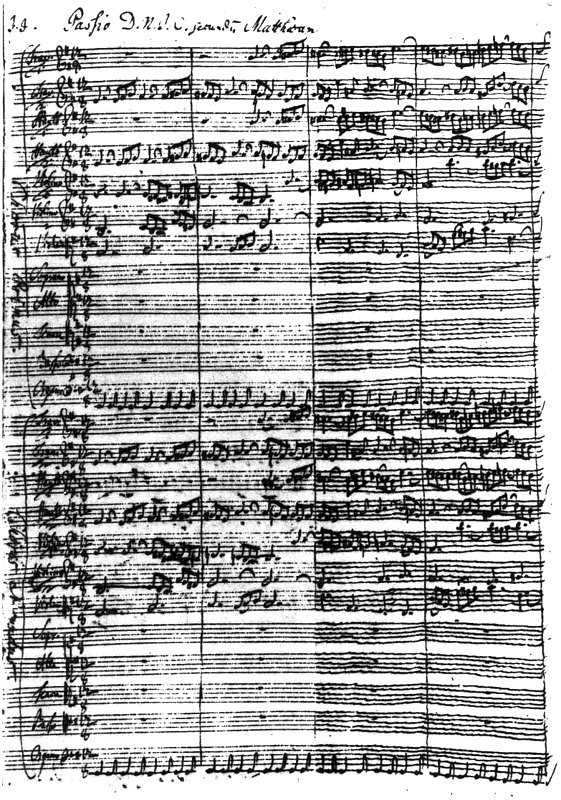
Example of J.S. Bach's manuscript from St. Matthew Passion
Subscribe to:
Posts (Atom)
