Monday, October 13, 2008

Report: KO's Oktoberfest

I have been quite remiss in my duties of reporting on Knoxville Opera productions.

Alas! There hasn't been that much to talk about, really. Last Friday's "Oktoberfest" dinner theater was basically a repeat of last year's celebration, only this year some selections from Romberg's "The New Moon" were added to the program. In trying to Google up some additional information on this year's production, I realized that there wasn't any. Hmm... Do we not have a full-time staff at the opera company now? Especially people dedicated to publicity? Reports on Oktoberfest? None. Reviews? None. Articles about the artists appearing? None. Articles previewing the event? None. I included in this search not only Google but local searches of the Knoxville News Sentinel and even the Knoxville Opera website which, if you're interested, contains plenty of information about last year's productions. (To be fair, a small note does mention that the website is currently undergoing a transition to its new form.)

Physicists sometimes infer data from sub-atomic collision experiments by seeing which particles are conspicuously absent from an event. We might borrow this technique to infer data about Oktoberfest. Since there appears to have been little or no publicity for the event, short of that mentioned in the direct-mailings sent out to former opera patrons, one might infer that attendance suffered... and one would be right. Rumor had it that over 100 plates were unsold. One hundred missing patrons doesn't seem that big a deal for a regular two-run production in the 1500-seat Tennessee Theater with ticket prices starting about $22; however, for single-performance dinner theater in the smallish Foundry at $100 a plate, that's $10K that's going to be missed in the KO's coffers!

In defense of the KO staff, Oktoberfest really wasn't really meant to be a public event anyway. It was a night of fun for current patrons, a kickoff of this season, a reason for all the opera-ites in the Knoxville area to get together and party with good food and libations, with a few laughs and an aria or two along the way. Consequently, in this sense, Oktoberfest was a great success! From the initial downbeat of Student Prince, event-goers came alive and participated lustily in the production, pounding their tables and/or beer steins in time with the music, giving a loud hurrah for the men's chorus and their antics, and heartily applauding the arias, duets, etc. The event was also a showcase for some of our new opera apprentices at UT to shine; certainly, also in that respect, the night was a success. (This author can remember harder times where apprentice classes weren't as first-rate as those we seem to be gathering together these days.)

As far as the chorus, I think I speak for all concerned when I say we had a good time, though not quite as good a time as we would have had if we'd had the women's division of the chorus with us. Though we have a plethora of male "characters" in the men's chorus, there is an equivalent and unique number in the women's chorus that, when blended in, take things to new heights. Fortunately, full chorus rehearsals for Nov. 1's "Glitterville" gala at the Tennessee Theater start tomorrow night, so we won't have to sit on our hands long to see them.

Which reminds me... I need to start learning some music.

Tuesday, September 23, 2008

"Renéesance"

This is the New York Times review of the Met's opening gala last night featuring a three-act (and three-opera) tribute to Renée Fleming.

Ms. Fleming chose to show off her voice in her three favorite roles: Traviata (Act II), Manon (Act III), and the Countess from the final scene of Strauss's "Capriccio."

"Renéesance," as well as "The Renée Fleming Fashion Show," were the memes that several opera bloggers had been calling this year's gala for the past few weeks, apparently mocking the big to-do that the Met had prepared, including three gowns especially designed for Ms. Fleming by famous NYC fashion designers.

But, despite the purists grumblings about an opening production being a garish tribute to famous singers, the show did go on. Reviewer Anthony Tommasini overall liked the production... um, productions?

What got me was that the performance was simulcast on a screen at Fordham Plaza and in 500 theaters throughout the U.S. and Argentina. (I must remember to ask Jerry or Vlad if Knoxvegas was included in those 500.) But what got me was the other large simulcast location in NYC, that is, Times Square. I can't make up my mind whether to be joyous at opera's appearance at what is basically the Pigeon Forge of the Big Apple or appalled that its pearls were being cast before swine. The accompanying picture to the article lends credence to the latter, I'm afraid. How anyone can sit in the center of four of NYC's busiest thoroughfares and try to listen to opera is beyond me. Between the honking of cabs (and probably loud cursing by the cabbies), the vagrants panhandling (don't let the NYPD tell you they aren't there!), Disney-store-bound tourists, and Broadway goers hustling to and from their artistic venues, how could you possibly pay attention?

But maybe that's just me. As I've revealed before, I'm ADD. The very presence of the multimillion dollar signage surrounding the square alone would be enough to send me into some kind of visual data overload convulsion. If that didn't get me, the presence of what appears to be a fluorescent-light rendition of the American flag apparently smack dab in the middle of the audience would. "Oh, really?! Renée Fleming was in those productions? I didn't notice." But that's NYC for you: Take a bit of every culture currently existing, add in art from Michaelangelo to the seediest porn movie, throw in a dash of sports and gobs and gobs of greedy businesses (Remember when Disney was considered a wholesome, family-oriented company?) and that's the bright lights, big city for you. And Times Square is the crossroads of it all... with Ms. Fleming and the Met on the big screen.

* * *

On a more local note: The Knoxville Opera gears up for its premiere gala on October 10 at the Foundry with tonight's first rehearsal of Reader's Digest versions of Romberg's "Student Prince" and "The New Moon." So much for the lazy days of summer! Guess I'd better be looking at the scores.

I wonder if they KO is preparing any simulcasts to downtown Gatlinburg in the near future?

Wednesday, September 17, 2008

Finale for Free: LilyPond Music Notation Software

I have been a user of Finale, MakeMusic's industry-standard music engraving program, on and off throughout its 20 years of existence. Two things have always frustrated me about it: the significant cost of the software and the huge time investment required to learn (and relearn) it.

On the user-interface end of my complaint, I recall a choral composition class I took in grad school in the early 90s: Our final project was to "publish" the project we'd been working on--both in the computer lab and in class--using Finale. I never could get my project to look the way I wanted it. After many hours of cursing in the computer lab, I finally threw up my hands, jotted out my work on regular staff paper and turned it in along with a print-out of what I'd been able to cajole Finale into doing. I think, with Finale 2008, I could do the task in a couple of days of on and off work. Unfortunately, the price point for the software has remained a sticking point: A completely new, full-blown version of Finale 2009, the latest, greatest version, will set you back $600; previous release owners may upgrade for "only" $149. To their credit, MakeMusic has heard the poor musicians' pleas over the years and you can now buy the "lite"-est version of Finale for $99, or even download a completely-no-frills version called, cleverly, "NotePad," for free.

But, despite Finale's dominance, alternative programs exist. For example, in Europe, the equally full-featured Sibelius is very popular. But for the past several weeks I've been playing with a very comprehensive and relatively easy-to-use software called LilyPond.

My two sticking points about Finale are rather moot with LilyPond.

First of all, LilyPond is free for anyone to download and install. It is based on GPL, the GNU Public License model of software development. Without going into too much detail (esp. about the "GNU" part of the acronym), basically, GPL is based on the idea that if we all try to get along and help each other, the world will be a better place. Software under the GPL may not be sold for profit; in addition, software is required to be collaborative, i.e., the raw computer code for GPL programs must be offered up for modification by other programmers as long as those programmers, in turn, offer their improved/modified versions up for modification by anyone else.

Second, LilyPond is rather ridiculously easy to use at its most basic level. The ".ly" files are merely text files. A budding composer may open up a regular letters-words-paragraphs-type note pad (not the Finale Note Pad) program and type in his score using very intuitive notation: For instance, if I were to transcribe "Hot Cross Buns," it would look something like this:

\relative c' {
e4 d c2 | e4 d c2 | c8 c c c d d d d | e4 d c2 |
}

The above notation would be translated--"compiled," in computer programmer speak--by LilyPond into a PDF file that looked like


which could be printed out and given to any musician.

Now, granted, this is a very simple example, but what is immediately evident to any musician is that, by looking at the above code, most anyone could hazard a guess at what the output score would look like. Better yet, anyone could type in that sequence of letters and numbers with a minimum amount of instruction. Wanna get more complicated? Try this:

\relative c'' {
\clef treble
\key c \major
\time 6/8

% You could notate "Chopsticks" as two separate voices on the staff

<<
{ g8 g g g g g | g g g g g g | b b b b a b | c4 c8 c b a | } \\
{ f8 f f f f f | e e e e e e | d d d d e d | c4 c8 c d e | }
>>

\break

% or you could notate it chordally

<f g>8 <f g> <f g> <f g> <f g> <f g> | <e g> <e g> <e g> <e g> <e g> <e g> |
<d b'> <d b'> <d b'> <d b'> <e a> <d b'> | <c c'>4 <c c'>8 <c c'> <d b'> <e a> |
}

And get this


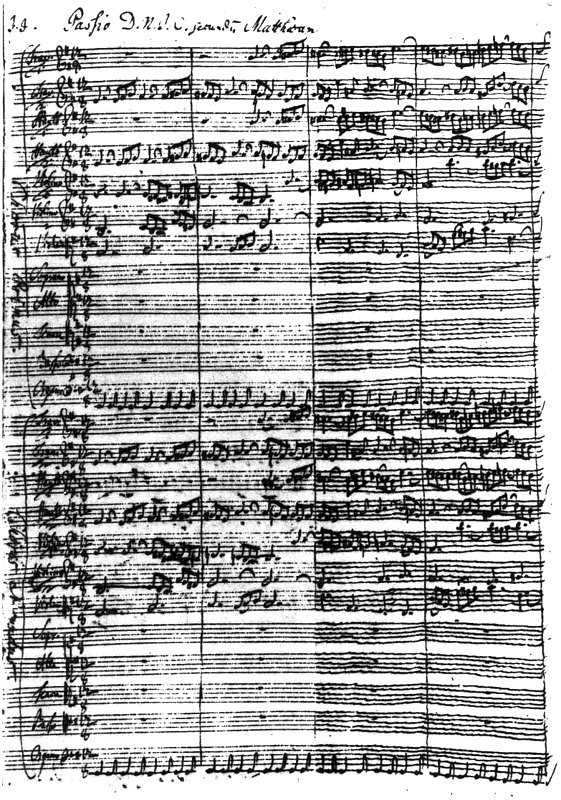
Obviously, some things do take getting used to--all the braces and brackets and such. And I admit that I'd be able to hack out "Hot Cross Buns" and "Chopsticks" just as fast in Finale. However, as the music gets more complex, LilyPond remains fairly easier to use. An example from the first movement of J.S. Bach's Cantata No. 78, "Jesu, der du meine Seele":


The cross-staff voicing is hard to do in both programs... well, it's pretty hard to do even when you're writing stuff out by hand, but, trust me, Finale's method is far more convoluted. To change the staff in Finale, you have to enter the music in its original staff, select the cross-staff notes, and then find the right tool dialog buried deep within many menu options... and hope you've made the right option selections. You'd then have to go back and add the cross-staff lines with another tool. Within LilyPond, you merely note "\set followVoice = ##t \change Staff = lower" within the score description.

Okay, complex music requires complex measures in both programs. But perhaps the best thing about LilyPond is that rather than developing code to draw and print music with a computer, the LilyPond developers studied the ancient art of music engraving, i.e., how publishers through the years have printed music on the page, and then designed their software to recreate those functions. I could go on, but the authors make their very cogent argument in favor of LilyPond in this article, as well as giving an excellent introduction to music engraving in general. (BTW, we call it "engraving" because the original printers of music in the 15th century used blocks of wood that they would engrave with woodcutting tools to create a "stamp" that would be inked and then laid onto blank paper.)

In sum, I've been very impressed with both the ease of use of LilyPond and the quality of the music I've printed with it.

Let's face it! The quality a printed score is of primary importance in the creation of the actual artistic entity that is music. Certainly, at some time or another, we've all had to read off of an original hand-written manuscript. Generally, composers are more concerned with getting ideas on the page than they are making their ideas clear to performers. Barring the actual presence of a composer to interpret the score when any questions arise, it has always been the engravers job to make the composer's ideas clear. While Finale and Sibelius (who each claim to be "No. 1" in the music creation business) will continue to dominate the market, the discerning musician will look for the best tool for the best job, the one that is easiest and fastest to use and creates the best score engravings. I definitely intend to make LilyPond--and some of its other incarnations/helper programs a large part of my musical scoring tools


Example of J.S. Bach's manuscript from St. Matthew Passion


Tuesday, August 19, 2008

What price, artistry?

An Associated Press article today added further fuel to the flame over the opening ceremonies of the Beijing Olympics.

Previous reports reprimanded Chinese government, filmmaker and production director Zhang Yimou, and NBC for adding digital fireworks to the broadcast production. Then came the hubbub over a communist party leader insisting that an attractive nine-year-old girl be broadcast lip syncing the Chinese national anthem while her supposedly uglier comrade actually sang the paean from a secluded room in the bowels of the stadium, safely away from the cameras.

Now additional word comes from various sources about the horrible toll the ceremony and its rehearsals put upon the performers involved in the spectacle. According to the article:
  • One performer was paralyzed from taking a 10-foot fall during a rehearsal
  • Other performers were injured when they slipped on the glassy surface of the giant LCD scroll that unfurled in the middle of the field
  • Some of the 900 performers under the boxes displaying the Chinese ideograms had to wear adult diapers to endure the 6-hour stay under their 40-pound charges
  • Many suffered heat stroke or other illnesses from the long dress rehearsals, one lasting a mind-numbing 51 hours!with little food and few bathroom breaks.
Apparently Zhang has nothing but contempt for Western performers, saying they needed frequent breaks and could not withstand any criticism. While he never spoke specifically of any of his experiences, one wonders if he was talking about opera performers; he did direct the premier of Tan Dun's The First Emperor at the Met in December 2006. Zhang says:
In one week, we could only work four and a half days, we had to have coffee breaks twice a day, couldn't go into overtime, and just a little discomfort was not allowed because of human rights.
Zhang continued, lambasting divas and performing arts unions:
You could not criticize them either. They all belong to some organizations... they have all kinds of institutions, unions... We can achieve in one week what they can achieve in one month.
There is an interesting dichotomy in these Beijing games. On the one hand, the Chinese have striven--and largely succeeded--in displaying how similar they are to more Westernized countries; on the other, as evidenced by the above examples, they have shown how much they still adhere to 1960s Cold War Communist dogma, where the people sacrifice all for the good of their country and countrymen. For instance, one of the 2,008 martial artists involved in the ceremony, a 17-year-old, said that he had nothing but "pure joy" in his heart the night of the performance.

But is this idea of "sacrifice" truly a Communist tenet? Or is it perhaps related to what we, as artists, face every day: How much do we sacrifice in the name of art?

Take your average opera singer. Most singers have spent years in classroom, practice room, rehearsal hall, and on stage to refine their craft. While many college kids are out partying, having a good time, getting wasted on alcoholic beverages or, perhaps, illicit drugs, and sewing their wild oats, the average voice student is either locked up in a cramped, hot, smelly, practice studio with an out-of-tune piano, struggling with refining his or her technique or trying to learn a new, more difficult aria; or he or she is stranded in the back of some warehouse-cum-rehearsal space down on the, uh... "less fashionable" end of town with several hundred others in equally desperate environmental conditions. Even those singers lucky enough to have avoided such intense operatic education know the discipline and--I tell some of my class voice students--athletic development required to sing properly. "Practice makes perfect," is the watch word for art.

So how much is too much? The throes of agony of a recent KO production have greatly added to the horror tales that choristers, staff, and crew alike tell during the latter hours of an, ahem, well-lubricated cast party. And yet, no production in recent memory elicited more of a reaction from the audience. Some loved it; some hated it; but rarely did they find it boring. As participants, we should feel a great deal of pride at those reactions, even though we put up with the late-night rehearsals, even though we spent countless hours waiting for our call, only to be dismissed, even though we all treaded that thin line between sticking with things and saying, "F**k it!" Would that all of our productions stir up such reactions from our audience!

Another example: I spent four years as an undergraduate in the UT "Pride of the Southland" marching band. Those familiar with college bands know that UT has one of the finest band programs in the country, and the "Pride of the Southland" marching band is a part of that fine tradition--a tradition that insists on hard work and high artistic standards. From the first of August until fall semester began in early September, we practiced almost daily. If we were lucky, we were allowed to rehearse music in the air-conditioned confines of the UT band room; if we weren't--and we often weren't--we had to spend up to 8 hours a day marching on the sweltering, then-artificial turf of Neyland Stadium, the brutal August heat and humidity of East Tennessee battering us at every corner. Things improved only marginally when school started: Marching band was actually a class you would take. "Classroom" (i.e., Neyland or a practice field) hours were from 7:30 to 9:30 am and then again from 1:00 to 3:30 pm Tuesdays and Thursdays, and, generally, 7:30 am to the end of the UT football game on Saturdays. The schedule for participating in road games could be just as difficult--load buses at 6:00 am on a Friday, ride 4 or 5 hours packed in like sardines, dress and give a lunchtime concert for alumni in whatever city we ended up near, back on the bus for another 4 or 5 hours, give another alumni concert in our destination city, then a marching rehearsal for a couple of hours before getting to the hotel. The Saturday road schedule was similar to home games, except you had to lug and load regular luggage in addition to instruments (unfortunately, mine was tuba). We'd either drive back home Saturday night or on Sunday. This went on every week from September to November. During that time, we had to learn up to six separate halftime shows, marching and music, to perfection while keeping our standard pre-game show, learned in those early weeks in the sweltering August heat, in top shape.

Did I hate it? Heck yeah, I did! It was a miserable existence! Being a commuter to UT meant I either had to pack a change of clothes on Tuesdays and Thursdays or go to afternoon classes in sweat-soaked jeans and shirts. It was usually the latter because, as a busy music student and band member, I had no time to walk six blocks back and forth from Neyland Stadium, retrieve or put away my instrument, and make my next class on time... even when it was in the Music Building. (My favorite semester was when I was forced to schedule a required sociology class located on the other side of "The Hill," approximately a mile from the Music Building, right after band. Fortunately, I had a prof that was very understanding.) It was very much like what I would have imagined army life would've been like: You get yelled at all the time, nothing you do is ever good enough, you never have enough time to do the things you need to do, and you were always sweating.

And yet, I loved it! I got great seats to every UT home game and almost every away game. (Today, the band has to sit in the south endzone of Neyland; when I was in school, we were located right down front on the 50-yard line!) I met a lot of great people, some still my friends to this day, learned to act like--and be treated like--an adult with personal responsibilities, traveled to exotic places (e.g., pre-Disney--i.e., ultra-sleazy--Times Square my freshman, and 18th, year), and generally got a whole lot of what I would call "life experiences."

Perhaps the most amazing moment in my life was being on the field for pregame at the 1986 Sugar Bowl in the Super Dome, not being able to hear myself play because of 70,000 screaming No.-8-ranked Vol fans. There were a few No. 2-ranked Miami fans there. Out of self-preservation, they were very quiet, and they left in the third quarter, just after I lost my voice from hollering and when the score was 28-7 Vols; final score was 35-7 Vols and, to this day, you can see both Jimmy Johnson and Vinny Testaverde wince when someone mentions the '86 Sugar Bowl.) Today, every time I hear "The Pride" playing any of over a dozen fight songs (live or recorded), I'm almost reduced to tears with overflowing pride, and every August, when everybody starts talking UT football, I'm as happy as a clam.

Perhaps the greatest mark of high art is that it does illicit strong reactions in people, that it does stir up a range of emotions within them. Although there is not a direct correlation between time spent on a work of art and its acclaim (or outcry), generally, the more and harder an artist toils on a work, the higher the final quality of the product... and, generally, the greater sense of fulfillment the artist has for his or her work. That was certainly true of my experience with the Pride of the Southland... oh yeah, and with the opera company... and with church choirs, and the symphony, and....

So, for the previously mentioned 17-year-old Chinese martial artist, Ren Yang, the long hours, the threat of heat stroke, the danger of injury--or even death (Being an acrophobic, I couldn't help but think what would happen if
gymnast Li Ning had fallen during his "victory lap" around the rafters
of the stadium to light the Olympic torch)--was worth it. For the rest of his life, Ren, and tens of thousands of performers like him, will remember these Beijing games. They won't remember being sick with heat stroke, they won't remember the fact that they could hardly walk with tired, sore muscles, they won't remember the stinging comments of Zhang over the loudspeaker in rehearsal, they won't remember the rainy rehearsals or the long nights at the "Bird's Nest." What they will remember is that they were a part of one of the greatest artistic spectacles to ever be seen on this earth.

So, I ask you, KO chorister, what are you willing to put up with to create incredible art?

Thursday, August 7, 2008

Your friendly neighborhood opera company

It seems that many of my entries lately invoke the name of the New York Times. Honestly, I'm not like a regular reader or anything. I'm lucky to make it through a few articles on the online version of the Knoxville News Sentinel and whatever headlines end up on my Yahoo! portal page. Alas! the KNS is hardly the place you would find news of the cutting edge of art except for the occasional informational "five Ws" article (Who-what-when-where-why).

So, in perusing stories on opera and music, invariably I end up with something from the Times. And it was here, in today's issue of the NYT that I found this article on a "shoestring opera company" in the Big Apple performing Monteverdi's "Coronation of Poppea." (BTW, there's an excellent, somewhat frightening, article about the Internet denizens of anarchy, also known as "trolls," in a recent issue. Nothing about art or music, but you know tech is another passion of mine.)

The article piqued my interest: Not just because it is a story about local, unemployed artisans banding together to create an opera performance on a budget that you couldn't buy a good, recent-vintage used car on; not because the company's focus is going to be primarily dedicated to performing Baroque operas with original instruments; but because, as I may have previously mentioned, I was fortunate enough to perform "Poppea" in school and have a special place in my heart for it. Better yet, NYC company, branding itself as "Opera Omnia," is doing "Poppea" in it's audience's vernacular, English. Understandably, if you're only doing a $15k opera production, you'd probably want to maximize your audience, and even in cosmo NY, you'd catch more flies with, uh... English, if you get my drift.

"Poppea" is a good opera to do, too, if you like a healthy dose of sex with your opera. The show deals with a young, ambitious courtesan (some say), named Poppea and her sexual domination (not black leather and whips-type, mind you) over the most powerful man in the known world at that time, the Roman Emperor, Nero--yes, that Nero. There are a lot of scenes with just Poppea and Nero, in his or her bed chambers making pillow talk. I suppose you could play those scenes in a Victorian manner, but, hey! This is the bright lights, big city, New York. Everyone either has a porno shop around the corner from them or they had one nearby when they were growing up. As a visitor to Times Square in the early 1980s, I counted more porno shops and peep shows in that area than you might find "Lion King" ads today. As an entertainment, you have to compete with the likes of "Oh, Calcutta," too, not to mention thousands of other, seedier, way off Broadway shows or artsy events that would definitely get someone locked up here in the Bible belt. UT's "Poppea" in the early '90s wasn't exactly prudish. Though Carroll Freeman had not yet come on the scene, we had an equally sex-obsessed Michael Erhmann as opera director back then.

And Baroque operas are good for small companies to do. Most of them have just a few characters and, in most cases, there's not a chorus per se. The later Baroque composers like Handel and Purcell were to change that, though. Despite the deus ex machina craze in the theaters of that time, many Baroque operas are relatively simple, stagewise. They were meant to be much more portable: the King's ballroom one night and a local theater the next. There certainly wasn't the explicit attention to detail that, say, Verdi or Puccini put in their descriptions of scenery.

I applaud Opera Omnia for their endeavor. I'm sure this is more of a labor of love thing than a "we're going to be rich" thing. The ensemble encompasses various young singers in their 20s and 30s and several prominent musicians in the New York area, a retired church music director. The article mentions the recent blossoming of various small ensembles that perform in unusual venues--bars and such. It even lists other opera companies in the city: Dicapo Opera Theater, Gotham Chamber Opera ("where opera gets intimate," according to their website), Opera Company of Brooklyn, Amato Opera of New York City, and Opera on Tap, which apparently seeks to turn opera performances into something similar to a rock or jazz musician's "gig." Of interest to local opera lovers: Opera on Tap has, uh... opened a branch office in New Orleans, sponsored by New Orleans Opera, where Robert Lyall, former KO director/conductor, abides as the General and Artistic Director.

I've often wondered whether something like what all these small companies are doing might be possible here in Knoxvegas. The theater companies around town seem to be able to do it. You've got the Black Box Theater, Shakespeare on the Square during the summer, as well as numerous other "shoestring" troupes. When I was singing with the Knoxville Early Music Project (KEMP) we did several quasi-staged productions. One was based on the life of the Elizabethan poet, Philip Sydney using his poems, his songs, letters, songs relevant to his time, etc. KEMP's perennial venue was the Laurel Theater, a small church which has been converted into a performance venue. The building lends itself to more intimate music such as that of the Renaissance and Baroque that we performed, and it might make a perfect space to mount a small opera production. Though the stage is tiny, there is lots of open floor space and you could do some marvelous "breaking the fourth wall" productions in it. There is even a balcony that might be suitable for an appropriately sized Baroque orchestra.

The problem for a micro-opera (I claim coining the phrase!) group in K-town? The usual suspects: Money, time, money, participation, money, and motivation. Knoxville can barely support a traditional opera company and its university feeder program. How can it support any other organization with "opera" in its title? Such a group would be on its own, probably. The KO needs to pay its own way and can nary afford to pay another group's way. Also debatable is how the KO might take the formation of another opera company in town. Would it support such an effort or see it as a threat? There would probably be some overlap between the two groups. Not a whole lot of opera singers to go 'round in this part of the country... at least ones that would be interested in performing pro bono for x number of years while the company got on its feet. Then there is the bane of so many now-defunct performing arts organizations here in town: Good management and administration. Many local musically inclined individuals have little experience with management, fund raising, hiring talent, etc. (e.g., myself). Those that do, do that kind of thing for a living, and would rather have fun singing than to sit at a desk and hound the two Jim's (Haslam and Clayton) for money. That is a hardly glamorous job, much less one that someone might be interested in getting paid McDonald's/Wendy's wages to do.

Still, the idea has intrigued me since a friend suggested it out of the blue a few years ago. She seemed to think that that might be something I could do. Personally, I don't see how a guy who can barely keep his own personal checks from bouncing every month to be put in charge of other people's money. But I could be coaxed into taking some other role, like artistic direction or just plain ol' singer.

I invite comment on the subject of a small opera ensemble in Knoxville. Let me know your thoughts.

Friday, July 18, 2008

Truly (Dr.) Horrible (Not!)

Found "Dr. Horrible." online today and immediately fell in love with it. It kind of fits my quirky sense of humor.

Okay, I admit it: Even though I pride myself on my geekdom, I've had a hard time getting into the "viral video" thing. (definition: viral video.) Yes, occasionally I'll click on a link and watch something on YouTube, but it's not like I'm going to YouTube every other hour to see what people are posting. For that matter, I don't usually watch any video on the web; I like the quiet of reading a news story on the web instead of watching an ABC News or AP video with concomitant preceding commercial. At least I can, for the most part, ignore the print ads, even the ones with animated monkeys.

"So, what's this got to do with opera?" you may be asking? Well, as far as "true" opera, nothing; it's more up the "musical" alley. During the recent Hollywood writer's strike, a few bored penners, Joss Whedon and his brothers, Zach and Jed, and Jed's fianceé, Maurissa Tancharoen, decided to get off their couches and do something fun with a bunch of their talented friends, something they would not have been able to do while employed: write, direct, and produce a short film on their own. The result is "Dr. Horrible," a web-only viral video musical adventure super-villan comedy miniseries, starring Neil Patrick Harris, aka TV's "Doogie Howser, MD" and currently star of the well-received CBS sitcom, "How I Met Your Mother"; Nathan Fillon from Fox's "Firefly" and its feature-length theater fodder, "Serenity", not to mention ABC's current hit, "Desperate Housewives"; and Felicia Day from Fox's "Buffy the Vampire Slayer."

Speaking of "Buffy the Vampire Slayer" (both movie and Fox TV series) and "Firefly" and "Serenity," Joss Whedon was the writer man behind all of them, not to mention other acclaimed TV/movie things like "Angel," "Alien 4: Resurrection," as well as less sci-fi things like "Roseanne" and even "Toy Story." He's currently working on a sci-fi series for Fox called "Dollhouse," scheduled for a 2009 premiere.

According to this story in USA Today, Joss and his friends set out to prove that out-of-the-box productions could make it in Hollywood. They gathered together some cash "in the low six figures" (to us, sounds like a lot; to Hollywood, it's a bargain basement production), brought on people they'd worked with (Harris, Fillon, and Day), and asked "What if?" "Dr. Horrible" was the result and, again, per the article, it has become everything a viral-video-maker dreams of: a word-of-mouth smash hit.

As of this writing, Friday, June 18, 2008, the first two episodes of the series are live on the web, free to view; the third and final installment is scheduled to be put up on Saturday, 7/19. However, the entire series will only be available for viewing through July 20. After that, the videos will only be available on iTunes for paid download (at iTunes' standard rates, $1.99 per episode). A DVD distribution is also planned at a later date.

And herein lies the "rub" about viral videos: No one has found out a sure-fire way of making any money off of them, even ones that have professional cinematography and brilliant writing. So they're left with uploading their work(s) to YouTube and hoping, somehow, that they'll be "discovered" by a Hollywood producer. Unfortunately, YouTube and Hollywood have not been on the best terms, given YouTubers penchant for digitizing and uploading Hollywood's copyrighted content onto the site for viewing by anyone--and this is the really contentious part--for free. However, things may be changing in that vein. YouTube has cut a deal with Lions Gate Entertainment to offer clips of its movies (ad supported) on the site; and Microsoft is allowing users of its TiVo digital video recorder hardware/service to download YouTube videos for viewing on their regular televisions.

And, lest you ask, yes, you can watch clips of opera performers and performances, past and present, on YouTube, although, like Hollywood's content, some of performances may be illegally uploaded, copyrighted productions. You can't be arrested for watching them should you so deem; YouTube is the responsible party. Some local and regional companies even put clips of their opera productions up for publicity and notoriety's sake.

Anyway, if you get a chance, I highly recommend seeing "Dr. Horrible." Think of it as a cheaper alternative to the film adaptation of the hit Broadway musical "Mama Mia," (which, of course, in turn was an adaptation of the music of the 70s supergroup, Abba... and I'm not bad mouthing, "Mama Mia"; preliminary reviews have been quite favorable.) So you have your choice of Hollywood film stars singing: Meryl Streep, Pierce Brosnan, and Colin Firth in "Mama Mia" or Neil Patrick Harris, Nathan Fillon, and Felicia Day in "Dr. Horrible."

Sunday, July 13, 2008

The lure of the supernumary

Found this article in the LA Times. Opera Pacific in Orange County is looking for supers for the upcoming year.

Okay, first of all, this is in the LA Times, but it reads like something you might find in the Knoxville News Sentinel or even the Farragut Press Enterprise. I'm not an elitist... at least, don't think I am... but I expect a bit more from the LA Times than I do from a local paper. I suspect that David Colker, "Los Angeles Time Staff Writer," pretty much was spoon fed this article by Opera Pacific. Granted, what can you say about being a super in a regional opera company? Go to a few rehearsals, see opera stars either on their way up or on their way down, wear a smelly costume, and give up a week or two of your life for production, get paid a few bucks, and revel in accolades--or jeers--from family and friends who see you onstage.

On a lark, I went to the link on the Pacific Opera website regarding volunteers mentioned in the article. Surprisingly, it closely resembles the KO website's volunteer page. "We need you to help with this and that--telemarket tickets, answer phones, help with fundraisers, etc." I didn't find anything about supers on our site, though. (One note, and I'm trying not to make this sound like a complaint, the KO website has nothing about the upcoming season on it.) Again, because here the KO is in K-town, a stone's throw up the road from hillbillyville, and there Opera Pacific is in a 'burb of one of the largest and most culturally diverse cities in the world. It's somewhat surprising that OP should have to beg (C'mon, let's be frank: that's what the LA Times article is) for people to help out, little alone perform with them.

But the kicker was when I opened OP's application for superdom (Microsoft Word format) . (In KO's defense, the OP application was for the past 2007-2008 season, so we're not the only ones behind the curve websitewise.) It's pretty specific, especially the section about being able to lift 40 pounds: "Do you have any physical limitations that would prevent you from doing this kind of strenuous activity? Y or N Please explain. if you would like. Wha?! Suddenly the opera company wants to know your medical history?! "Took a bullet in 'Nam; nearly died; have artificial titanium and nylon hip socket that aches if I pick up shrieking sopranos. That explanation enough for you?" And it goes on and on! Nearly four pages worth of personal info: Your performance history, availability, wig-and-makeup knowledge, etc. I'm surprised they don't ask for transcripts and a copy of your medical files. I can just see Don T. asking some of our regular supers questions like these... or any of us choristers, for that matter. That would be interesting to watch. "You want to know specifics of my hysterectomy? As if!" Oh! And I forgot! OP wants a full-length photo of you submitted with the app.

It's funny, though, how different KO is from OP. Don rarely has trouble finding enough supers for our productions unless it's some kind of huge crowd scene. We have our usual suspects that return again and again, year after year. I wonder how much turnover OP has in the super department? It must be more than KO's. So, apparently, we're doing something right. Maybe it's because we are kind of a family at KO. I would imagine that OP, being in a more "professional" town might not be that way. It may not be that OP is a fun place to work, that everyone, by and large, tries to enjoy themselves at rehearsals, and wants everyone else to enjoy it, too. Sure, OP is a probably a lot more efficient at staging (supers are only called about eight times, according to the OP website), but is that worth having a good laugh or two? Maybe so, maybe no. And speaking of "worth," OP pays $5 a rehearsal and $10 for performance to supers; I don't know specifics, but I suspect that Don insists on our guys getting more than that. Maybe in LA there are more people slavering to see opera singers up close and personal and would do the super job for free if they had to.

Curious, I tried to find specifics out about the OP chorus, but the website only said something like "come back soon." So I looked up the OP staff, hoping to find a chorus link there. I didn't find what I was looking for, but what I did notice was the massive amount of staff that OP has to support, everything from "President and CEO" (a titular position? doubt that, given the "CEO" moniker) on down to "Ticket Services Associate." I count about 30 people on the payroll at OP, assuming all of those listed draw a paycheck. What's that? Like, 200% more than KO has?

Well, I suppose that, given its location, OP has a broad base of support (read "money") and can afford to do four productions and four performances, and has ample crowds to back them up. Still, from a super standpoint, wouldn't you rather be here?

Wednesday, July 2, 2008

Live Streaming Bayreuth

So, you don't want to be on a waiting list for seven years before getting live tickets to the Bayreuth Festival, and you don't want to wait the several years for a potential DVD to be released of the performances there (assuming they're acceptable and marketable enough for DVD). What's a Wagner lover to do?

Technology to the rescue! You can experience all the thrills of live, grand Wagner from Bayreuth from your office or easy chair... well, "live" streaming audio and video, anyway. For those of you who aren't tech officiandos, "streaming" means sending a digital real-time audio-video broadcast over the World-Wide Web. Cameras and mics capture the action, the picture and sound are digitized and broken into packets of data that are sent to a central distribution hub that creates copies of those packets and sends them out to computers all over the Internet where they are reassembled into a "live" audio and video stream to play on your monitor and through your computer's speakers. Yes, technically, it's not "live" live--there is a delay of a few seconds to a few minutes--but a little research will reveal that even "live" TV shows are rarely not on a few seconds of digital delay, especially in the post-Janet-Jackson-Superbowl-halftime-show-wardrobe-malfunction era. That's about as live as things get without being there in person.

Of course, Bayreuth will charge you for it: $77 to be exact... per production. Ouch! But, wait! Think about that for a minute: Think of it as pay-per-view. A quick check of my own local pay-per-view events lines up as such:

  • Ultimate Fighting Championship 86 - $44.99

  • TNA Wrestling - $29.99

  • WWE Wrestling - $39.99

  • Boxing - $49.99


Soooo, $77 is not that big a stretch, is it? I mean, if you're plopping down fifty bucks to watch a live-action cartoon... You need to face it! That's what wrestling is, right?... Why not spend the extra $22.99 to watch something quality? And while wrestling will entertain you for the requisite two hours, with "Meistersinger" will keep you enthralled for about five hours. (I'd be very curious to see a show of hands of people that would fall into the demographic of both events, please.)

Okay, let's compare apples to apples, shall we? The recent high-definition rebroadcasts of Met productions run, what? $24 or so? And those were "canned" videotaped productions in which a performance was filmed and later edited out for content and run-time. Hardly live. Ah! I recently documented a simulcast of a San Francisco Opera production at AT&T park. Hard to beat the price there--free. Of course, you won't have the comfort of your own couch, the convenience (and thriftiness) of your own fridge, and the use of your own personal bathroom for that... and you certainly can't see the performance when you're, uh... indisposed. However, thanks to your trusty laptop and a "wi-fi" router/switch in your home, you're more than welcome to drag "Götterdämmerung" in with you. (Yes, I know it sounds gross, but surely you've drug a magazine or novel in there... or maybe you've already installed a TV in your "'loo.") You won't miss a minute of the action.

Or you can just wait for the DVD to come out this November.

Monday, June 30, 2008

ADHD Entry

I think I've mentioned on occasion that I suffer from attention-deficit disorder. So, in honor of that, I submit today's "all over the map" entry.

"Drive" for Dallas Opera

Just a note about Dallas Opera's fiscal success this year. And building a new performing arts center to boot!

I suppose that, given all the oil money that floats around that town, you should take some (very) small consolation that you are helping the world of opera the next time you fill up your tank.

Do we really need to see that?

An article in yesterday's Sydney Morning Herald (Would that be our today or their yesterday?) refutes the rumor that Opera Australia demanded that German director Elke Neidhardt clean up an apparent "Full Monte" scene planned for her production of Don Giovanni. Nevertheless, Hungarian bass Gabor Bretz will be wearing a G-string when he steps out of a shower on stage. Neidhardt does seem a little flustered about that addition to the costume budget, and gives, uh... "ample" (?) examples of recent on-stage nudity in European productions. (Supports my recent monologue on German opera trends.) I tried to Google (insert own risqué joke here) the English National Opera production she referenced, but couldn't find it. But this article appears to support the hypothesis that, by East Tennessee's admittedly Bible-belt standards, the ENO has no problem with, um... ah... "progressive" attitudes on staging.

Puccini... Reconstructred

Everyone wonders how "Turandot" might have sounded had Puccini completed it in toto before his death. But some are more interested in the first performances of what we today consider "finished" works.

Case in point: Puccini's "Edgar," which was so ill-received at its premiere in 1889 that Puccini undertook an extensive revision of the work to make it more audience friendly. That sounds a bit ominous, given what Hollywood writers regularly do to great literary works to make their movie adaptations more "audience friendly.", i.e., dumb them down, change scenes, endings, characters, etc. But, in the case of "Edgar," at least, someone has seen fit to attempt to un-revise Puccini's work back to its original form. The editor/re-reviser, Linda Fairtile, head of the University of Richmond (Virginia) Parsons Music Library, undertook the project as a labor of love with Puccini's publisher, Ricordi, and was surprised to find that the Puccini family was very interested in it also, contributing missing pieces of the original manuscript. The revision of performed last Wednesday in Turino, Italy, with Ms. Fairtile in attendance.

Tuesday, June 24, 2008

Carmen Smuggler Trail Found!

Check out this video! (Acrophobics be warned!) Bizet could not have known of this trail when he was writing Carmen, (the opera premiered in 1875; the walkway wasn't built until 1901) but I'll bet he was imagining something of the sort. As luck would have it, it is in the very gypsy region of Andalusia in Spain. Prends garde de faire un faux pas! Prends garde!

If that doesn't get your jollies on, I found this link last year about a trail in China that makes the Camino del Rey trail above look like the Cades Cove loop (in the Great Smoky Mountains National Park)!

Now, the next time you complain about lax safety regulations in the U.S....